
Healing and the Sick Person (Part 2)
The following are taken from thirty-five-year-old notes that were used for various presentations and discussion groups. The graphics are clearly from that era, created on a Mac SE and salvaged with some effort.
Our reason describes aspects of the structure that constitutes this marvel of personal being. The intellect brings the patterns that constitute universal order into the light of rational consciousness. Because of this cognitive capacity, we are able to understand and affect the world in which we participate. The knowledge we have about ourselves and the techniques we utilize in affecting change, because of their complexity and enormity, are categorized into a variety of fields of study; one of these is psychiatry.
Psychiatry is a branch of medicine which focusses on the study and treatment of disorders related to the individual’s behaviour and experience of himself in relation to the world. It shares with other major medical specialties, the aim of healing the sick person. What this entails is a source of much ongoing debate. This is not unexpected, given that this pursuit raises questions that have been with us since humankind first began to reason.
Firstly, if one hopes to assist in the healing of the sick person, one should have some understanding of what constitutes human nature. Then too, there has to be a way of conceptualizing what the nature is, of the ills that befall us. Given a framework for understanding what it means to be human and to suffer sickness, one arrives at a third question: What can be done about the situation?
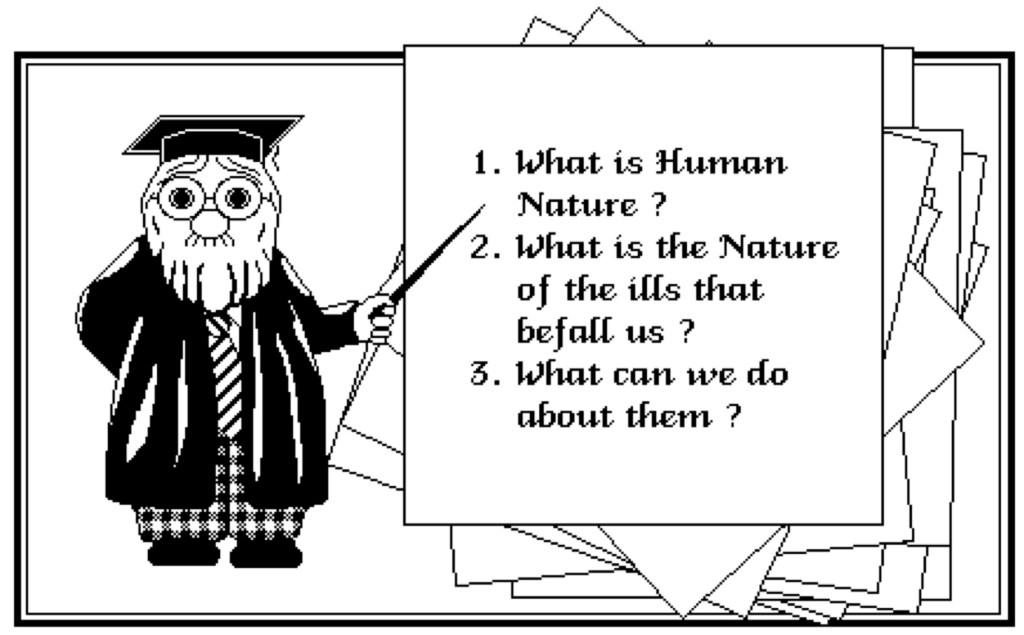
In the search for answers, a wealth of knowledge has been elucidated and organized into a variety of often conflicting approaches. The diversity naturally reflects differences in the way we integrate the material into meaningful systems for ourselves. The particular orientation would be an expression of one’s own background and interests, of one’s view of and relationship with the world. Since psychiatry is an applied science, its interest lies in formulations that are firstly, testable and consistant with the accepted truths of other scientific disciplines and that secondly, have practical ramifications when it comes to treating the psychiatrically ill patient.
Questions regarding the human condition are inevitable to the psychiatrist interested in understanding his patient. One cannot determine the nature of a psychopathological process without some conscious or unconscious reference to what it means to be sane and hence human. Psychiatric disorders arise out of and are a part of the human condition. They occur in persons and one is compelled to address questions regarding the essential nature of humankind, if one is to gain deeper insights into the person presenting with psychiatric difficulties.
The descriptions of human nature found in the psychiatric literature, are varied and draw on a number of sources. Generally speaking, the psychiatrist attempts to arrive at an understanding of the person in terms of social, psychological and physiological factors. Included often under the label of psychological phenomena, are spiritual aspects of the person.
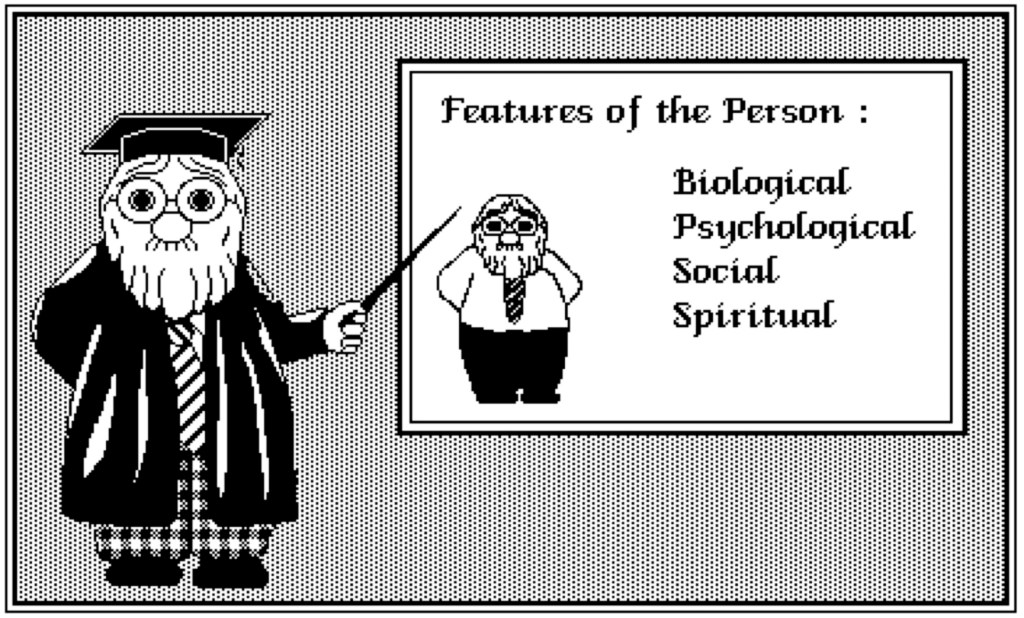
As body, the person and the universe which contains him are conceptualized as physical structure. In this light, human activity is understood in terms of its biological and hence evolutionary basis; all behaviour, both psychological and social, is assumed to have some biological correlate. However, while other sciences: physics, chemistry, biology and ethology, provide us with a vast amount of information as to what constitutes the person, they cannot be expected to provide the whole picture. There is is more to the person than simply the physical principles that make up other branches of science.
Psychiatry, in order to more fully comprehend and treat the person, does not restrict itself to the neurophysiological processes which govern behaviour; the person also exists as a symbolic entity within a world of meanings. The person’s behaviour begins to make sense as one comes to know how he understands the universe about him and the messages he is trying to convey to others. This type of knowledge comes about through a dialogue with a person; in the process, one comes to know him as psychological structure.
The psychiatrist enquires about and interprets the patient’s view of himself-in-the-world in such a way as to gain insight into developmental disturbances, regression, anxieties, disorders of affect or abnormalities of thought. What is sought is an understanding of what biological, psychological, and social factors have come into play and resulted in the clinical picture that the patient presents. The person, however, is more than the sum total of the etiological factors; the actual experiences, their interpretation and emotional flavour are real, personal and inescapably integral parts of the individual’s existence. This dimension is that of being; in order to more completely understand the person it is also important to appreciate how he deals with the fact of his personal existence.
In pursuing the question of human nature one may attempt to understand the person as a being consisting of matter which interacts in specific ways that can be more or less predicted and manipulated. The person is also a system involving meaning; matter, in terms of this dimension, may be seen as the dust whose specific configuration is the actuality of each particular symbol. We can describe a particular behaviour as being constituted of certain patterns of material interactions occurring within the body and its environment; it may also be understood in terms of intrapsychic and interpersonal communication of feelings and ideas. Beyond one’s understanding of the person, lies the reality of the person in himself. Viewing these systems of meaning and physical interactions from this perspective of beingness, one sees them as expressions of the universal creativity in which the person participates. In addition to the physical and psychological spheres, there is also a transcending spiritual dimension.
This spiritual realm is that of existence; being, will, and meaning are aspects of this dimension of the person-in-the-world. As one leaves the material and enters into the areas of the psyche and the spirit, the search for understanding becomes more personal and hence more difficult to communicate and prove. Dealing with matter, one manipulates variables in set ways in order to test a particular hypothesis. Hypotheses having to do with the meaning of a particular behaviour, on the other hand, are validated through their ability to elicit meaning within the other. An interpretation may seem to be perfectly plausible and correct; yet if it is unrecognizable by the patient or if it does not act as a seed for further growth, it has failed to achieve its desired end and consequently remains unvalidated. Proceding further from the material and the psychological, we arrive at truths that are personal, having to do with individual beingness.
The traumatic experiences which induce the person to seek psychiatric intervention, have both physical and psychological correlates; because these are happening to the person, they additionally possess a spiritual quality. The particular situation typically calls up such existential realities as death, guilt, meaninglessness and aloneness. The trauma is thereby associated with anxiety and despair: conditions which play a central part in all human suffering. In appreciating the traumatic events from the depths of the patient’s personal existence, the understanding that ensues is transformed from a mechanical discussion of forces and processes to one which is best termed compassion.
Compassion is an essential element in the therapeutic setting. The healing process which sees the patient out of his predicament, involves a reintegration of his sense of himself which is accompanied by increasing self-acceptance and the capacities for self-affirmation. These latter qualities are spiritual attributes, related to love, will and courage. They flower in an atmosphere that seeks ever deeper understanding of the person. In such an environment, one can be oneself. Anxieties and despair can be confronted and one finds the courage to act, thereby transforming oneself and the world. It mirrors the ground of being.
 Louis Canella, M.D.