
The following was not edited, but served as the basis of talks and seminars. It would need considerable work, but I’m thinking of perhaps bringing the chapters in this section together in the form of a book that would complement “All Creation, Loved into Existence”.
In addition to being Body, the person also exists as Mind. She inhabits a dimension of perceptions, thoughts, emotions, memories, and desires. These psychological phenomena have in common, an underlying structure based on systems of meaning which are intrinsic to the person as a human being, and which are developed through her involvement with family and culture. Human experience is a complex web of intellectual and emotional components and interactions. The person however, is more than merely a collection of interrelated parts or processes. The various aspects of mind that we define, are experiential fragments discerned from the whole and living reality that is the person-in-the-world. The person is ultimately a unity exhibiting a variety of mental, physical and spiritual qualities which reflect her role as a player in a cosmic drama whose stage is set within encompassing worlds of meaning, matter, and being.
The Structure that is the Dimension of Mind: The person is a conscious being who, at any stage of development, has some awareness of herself and her circumstances. She experiences her being in the world: sensing, interpreting and reacting to events that occur within and on the outside. The organizing principles that shape her experience include those associated with the category of body. In addition, there exists another structural system: that of mind. Whereas physical events involve material interaction, the principles that govern the mental sphere have to do with meaning. Within the person, symbol forming activities bring the universe to light experientially. Through the creation of symbols, the patterns that give reality its structure, become an integral part of the person’s awareness.
The person experiences and also acts upon her world. Central to both are unconscious wants sitting deep within the human heart, wants which make themselves known in dreams, thoughts and action. Given her particular circumstances and the variety of fulfillments she seeks, the person isolates and integrates those features of the environment that hold meaning for her; through acts of individual will, she transforms the world and, in the process, reveals the truth of her own unique existence.
The Physical Universe.
The illumination and transformation of the world through mental operations involves a reciprocal interaction between the person and specific aspects of the universe. This relational quality is an essential feature of psychological phenomena. The contents of consciousness arise out of the person’s participation in the world and reflect the different ways in which the person meets the world.
Through her involvement the world, the person has reflected back, images of her own nature. She relates not only to external events, but also to internal processes involved in the structuring of her experience.
Seeing, touching, hearing, tasting and smelling, we become cognizant of particular aspects of the world. Basic data about an object is detected through the gateways of the senses and is further elaborated into an experiential moment. Out of the moment, the relationship between the person and her surroundings flowers into a meaningful conscious reality.
While any experience is related to some particular event in the present, both the event and the mental organizing structure have a history which determine their current forms. The pattern, for example, of light that strikes the retina is set by the infinite series of events that went into the creation of its origin and the factors which influenced its course towards the eye. The person too, is changed with each experience; the meeting between the person and the world generates a continuously developing, multilevel lattice-work of interrelated mental phenomena which are unconscious and manifest themselves in the creation of experience. As part of the very making of each moment, this psychological structure is transformed. Though present becomes past, the moment exerts a continuing influence through the changes it has brought on the living mental system.
Because of the existence of the Carbon atom with its particular chemical properties, biochemistry is possible and hence biology. Perhaps the most amazing of carbon-based molecules is that of deoxyribonucleic acid (DNA). Phosphoric acid, a sugar, and four nitrogenous bases (two purines and two pyridines) combine to form two lengthy trains of complementary helices which have the astounding ability to self-replicate and also code for essential cellular constituents and processes. The molecule reproduces itself as the double-helix separates and each strand assimilates complementary bases with the assistance of other molecules that were originally coded for within the pattern of bases within the DNA. Through the activity of RNA, the pattern of bases is translated into one of amino acids on proteins. Proteins go on to provide the enzymatic activity that allows for cellular metabolism, as well as providing much of the structure and form of the cell. Each DNA molecule, coiled up on itself and combined with proteins, forms a chromosome. During the process of cell division the DNA replicates itself and forms identical chromosomes which separate and migrate to opposite ends of the cell which then proceeds to split itself in two. Because changes, resulting from a variety of factors, can occur in the DNA structure, we find a constant process of mutation occuring in nature. This process is understood as an important primary factor explaining the diversity of life on earth. Whether the new organism, characterized by the new proteins it produces, survives to replicate, determines whether there will continue to be organisms with similar traits. Within the basic structure of the universe, then, there lies the possibility of evolution and hence ourselves.
Whether this is interpreted to mean that life is a chance occurence, or the converse, that there is a meaning or destination which was set at the beginning of time, it remains a valid fact that the structure of Carbon makes possible the process by which increasingly complex molecules combined in a primordial soup covering the earth and formed the first cells. These complex collections of biochemical reactions, flourished as they continued to divide, incorporated new material within themselves and overcame destructive elements. The evolutionary process is associated with changes in DNA base sequences that result in the development of cells having new qualities; it may be that certain cells divided, in the earth’s remote past, giving rise to offsping that entered into a symbionic relationship because of their each possessing specialized functions not possessed by the other. Perhaps it was in such a way that the first multicelled creatures came into existence. Whatever many other factors were and are involved in such a intricate and mystifying process, this unfolding of life, whereby increasingly sophisticated organisms, and we ourselves, have been brought into creation, this miracle of personal existence, is intimately and necessarily tied to the structure which is the physical dimension of the universe.
Operating at various levels, learning is sequential and involves the development of psychological patterns that shape the particular perceptions and understandings involved in bringing the universe to conscious light. The structure that underlies experience matures as the person passes from the earliest to the last stages of human life. Initially, learning predominantly involves the organization of stimuli into perceptual phenomena. The quality of experience becomes more intricate and more conceptual with the acquisition of words and names that signify particular events. With further development, the person is able to intellectually free herself further from the immediate and the concrete and deal with complex abstract concepts.
Ideas are linked to one another; feelings are associated with thoughts and all these are connected to forms of motor activity. Learning requires the formation of associations which enable one to arrive at concepts, images, recollections or actions given specific signs. Through ongoing interactions with the environment and the repeated exercising of the person’s faculties, the innate ability to perceive and comprehend evolves thereby allowing for more complex interactions with her environment.
The Sense of Touch
The past lives on consciously as memory which allows for understanding and the creation of a more-or-less coherent story of what the person has been through. Memory has short- and long-term features. We are able to keep in mind, impressions of what recently transpires and, as a result, can follow a line of thought. During the course of a conversation, we grasp each statement, moving on to the next word so that a connected understanding develops of what is being said. The information is stored for a brief period and may be lost to varying degrees with the passage of time. Long-term memory relates to the retention of information, feelings and scenes over greater periods. Juxtaposing a few key ideas images or thoughts, will open up sections of the psychological map which contains the record of our ongoing relationship with the world. With every experience there occurs some change in this unconscious multi-axial, interconnected organization of impressions, emotions and meanings which records the history of one’s participation within the structure of existence.
This psychological structure exists outside of human awareness as a system of intangible organizing factors giving form to the particular contents of awareness. Like the totality that goes into the making of any object, be it inert matter, a living creature, another person or oneself, the structure that underlies experience becomes known through mental processes which isolate elements, identify patterns and integrate the various components of the structure into meaningful models. Until she is able to conceptualize them, the person remains intellectually unaware of aspects of her own psychophysical structure. The determinants of human behaviour may thus be considered to lie within the Unconscious which, to the rational mind, is the realm of unknown Reality and includes all that has no mental symbolic representation. These forces, processes, patterns: whatever one would call them, are phenomena which exist nonetheless as intrinsic aspects of experience.
Interneuronal Communication
The psychophysical structure that underlies experience is brought to light intellectually as a collection of principles (neurochemical, psychodynamic etc.) and ideas. The descriptions and explanations are arrived at in a painstakingly through much observation, experimentation and creative thought. Because the living structure is not readily known, it may be understood as being unconscious. In actuality, it is not so much that its is unconscious, as it is that the person is so totally engrossed with its manifestation (the actual experience of the moment) that she does not realize what it is that she is doing. The psychophysical structure is contained within the experience and appears like hidden clockwork as it turns its gaze upon itself. Without some form of introspection, this structure can be said to be unconscious though clearly it is existentially and experientially real.
TWhen speaking of the Unconscious, one may refer to yet another aspect of the person: that part of her that is the Void, the creative Centre from which she springs. The person exists as a potential which she expresses and thereby brings herself into existence. The hopes and fears which guide her destiny shape her perceptions and her understandings. Acting upon these, through the choices she makes, the person brings herself out of the realm of possibility, and into existence as a concrete being.
That which comprises one’s totality, for the most part lies outside one’s awareness, both as a collection potentials, and as a result of one’s enthrallment with the experience of the moment. Through the creative activity which characterizes life and which includes the cerebral act of self-reflection, the person transforms herself from unconscious subject into known object. Given her unique existence and circumstances, the person’s existence is a creative expression of potential while her past is a testimony of what she has thusfar brought into existence.
Once made real by virtue of their expression in time, aspects of oneself result in the development of a notion of “I”. Through her interactions with the world, the person attains an awareness of the fact that she is actually seeing, feeling and thinking, and who she is within the larger physical, psychological, social and spiritual spheres about her. A sense of identity arises reflecting her perceived role in relation to significant others. This imagined self is a complex multidetermined universal quality of the person which develops as the figure of one’s actions emerges from, and is viewed by reason within the context of, the background of possibilities.
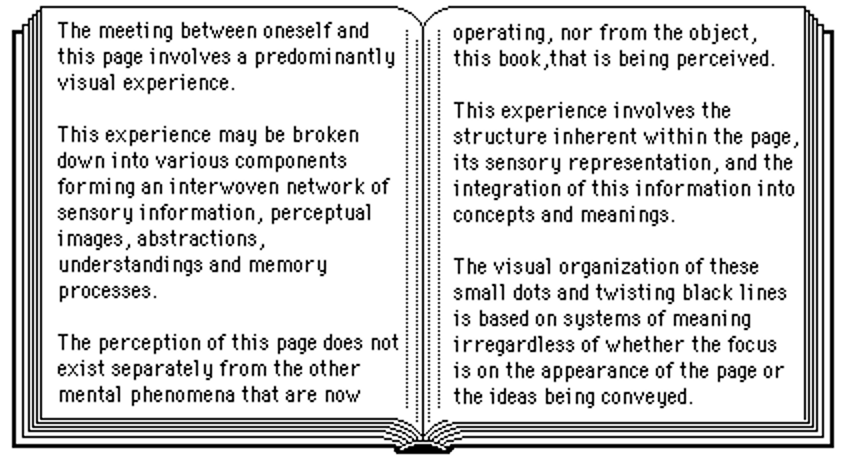
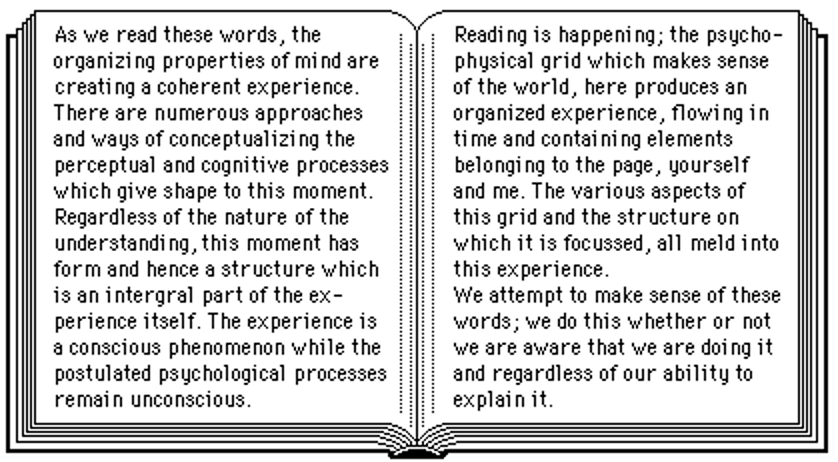
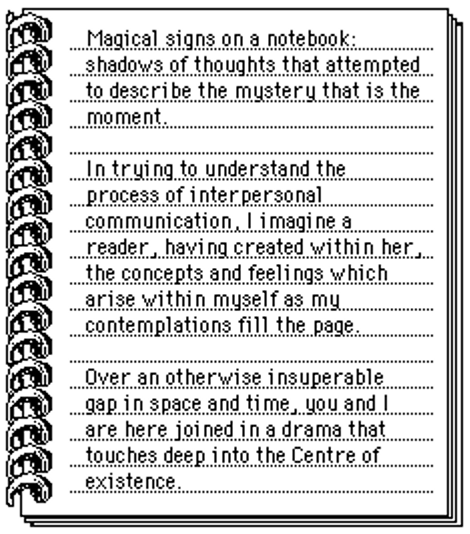
Focussing here on these particular words and letters, these markings that appear upon a white background, allows us to contemplate the complex structure that allows for the communication of ideas and the nature of comprehension. Perceiving and interpreting these configurations, reader and author darkly make contact.
Whether the object is some aspect of oneself or of the external world, it is united with the subject in the creation of experience. Mind immerses itself within the object. The complex structure that constitutes the person’s mental faculties, is intertwined with that of the object. However, although subject and object are one within the experience, paradoxically, experiential phenomena are possible only because they are distinct; it is their separateness, that permits the ensuing relationship. We, as objects of one another’s understanding, relate as separate beings. Each of us is a unique expression of mind and, as such, experiences the world privately. Our individual awareness of the world can be shared with the other, but only through some form of communication. Possessing similar emotional and cognitive patterns, we are able to understand, empathize with, and love one another.
Intellectually, the person forms a relationship with his world through the exercise of her reason. Gazing inwardly and outwardly, it sets order to a flux of seemingly unfathomable depths. The sciences are organized approaches to the accumulation of knowledge; they provide techniques for the acquisition, testing and communication of information and ideas. In seeking to order the world, we have developed the physical sciences as a way of approaching and understanding material events; in seeking to know another person, we require a different methodology and conceptual framework which reflects the difference in the area of study. The study of another person differs from that of material interaction in that the person firstly, has a subjective nature and secondly, exists as a participant in her creation. The reality of the person in fact, transcends concepts of subject and object. Though rooted in the subjective, and hence the unknowable, she remains an object, a part of creation which can be known.
The person is observer and actor, bringing into her relationships, those characteristics that define her. Her perceptions and understandings, as well as her subsequent actions reflect the hopes and fears that stem from her desires: that which she wants. Her individual point of view and her actions are shaped by a number of factors including past experience, perceptual and intellectual capacities, and also the technology she utilizes in extending her senses, her mental and her physical capabilities. Although experience rests on the mysteries of Will and Being, it can also be seen to be an objective event which occurs as part of a psychological reality.
In attempting to discover those inner truths that govern personal experience, the basic tool is one of empathic listening. The investigator attempts to find within herself, the experiential realities described by her subject. Whereas physical structure is understood in terms of cause-and-effect relationships, the person’s behavioural and experiential nature is elucidated through interpretation. Patterns are identified and communicated back. One seeks to ascertain, rather than cause-and effect relationships, the significance and meaning of an event or behaviour for the person. Delving deeper into the life story of the individual, each expression of the person, each part of the emerging picture of psychological structure is seen as suggesting the whole which in turn explains each aspect of her totality. With each expression of the person related to the whole and a manifestation of a more comprehensive purpose, psychological phenomena may be understood as being multidetermined and having layers of meaning. In the attempt to grasp the psychological reality of the person, a radically different type of understanding emerges than that found in explanations of physical phenomena.
Ultimately, the collection of mental processes which can be discerned and described are but fragments of the wholeness that is the person-in-the-world; the truth about her lies not in any collection of these aspects but rather in the living drama that encompasses the totality of her existence in the world. There ever remains a transcending aspect to her, always beyond reason’s grasp. She who is the thought, the understanding, the Knower cannot be a content of that understanding. Ultimately, the relationship is between this timeless Self and creation with which She is paradoxically One.
The Person as a Psychophysical Unity: Exploring human nature, we discover an abundance of diverse phenomena which appear to be organized into the functional and structural systems of mind and matter. Materially speaking, we are made up of physical, chemical and biological events which are described by the natural sciences. While a variety of theories illuminate what it means to be body, they do not assist in clarifying that aspect of the person which has to do with meaning. The subjective experience of the person, her perspective and the significance that specific events hold for her, are components of her psyche. The person is not solely a physical entity; the contents of consciousness can no more be reduced to descriptions of physical phenomena, than matter be portrayed as some function of mental life, without an existence in itself. The other side of the paradoxical entity which presents itself on the one hand as a collection of mental events, is on the other hand fashioned along the lines of brain physiology. Matter and mind are classificatory terms which relate to different sets of principles that describe the person’s being in the world.
One’s ultimate view of the person depends on one’s focus and the techniques that one utilizes in obtaining the information. Gross anatomy, histology, biochemical studies are among a long list of approaches providing models which describe the various strata of material interaction. From symbolic phenomena to brain chemistry, the information and view varies with the particular relationship that is established with the person.

Someone tells a joke; her breath passes through her vocal cords and mouth and emerges as a set of vibrations in the surrounding air. These vibrations, in turn, produce a series of changes in the tympanic membrane of the listener. The pattern is transformed, within the middle and inner ear, into one of neuronal communication through cellular membrane and synaptic changes. There is further processing of the message within the various midbrain, limbic, and cortical areas of the brain. The effect is, in turn, felt throughout the body as blood pressure, heart rate, respiratory, and muscular changes ensue. This happens because the joke has a meaning; it is funny and the person laughs.
Without an understanding of what “funny” means the activity we observe makes no sense. This very looking for sense or meaning to behaviour, itself reflects our being psychological beings. We organize events in terms of their meaning or significance. Even if one observes that all seems purposeless (especially in this case), the reality of the person as a being that structures experience into systems of meanings is clearly evident.
Localization of Brain Function
A crucifix sparkles on a golden chain which rests on the neck of the beloved. As a physical event, it is a collection of interacting atomic processes; innumerable physical processes are involved as it reflects and absorbs the light shining into the room. These events interact with a the physical phenomenon that is the person’s nervous system. A series of neurological reactions is evoked resulting in the particular emotional reaction of the individual. The response, having both physical and psychological qualities, may be described using remarkably different metaphors and concepts. What transpires when a certain individual sees the crucifix can, taking a physical perspective, be discussed in terms of photons, cellular membrane changes and so on. Psychologically, there is another set of patterns which govern the response and which have to do with personal, familial and cultural factors. The crucifix and she who wears it, her beauty, and the yearning she evokes are among other aspects that combine to make her who she is, in the lover’s experiential world. The psychological is one dimension of what is, at the same time, a complex material event. The perception would not occur were the beloved, and her communications, not physical; nor would the lover be able to see her, if he did not possess the necessary neurological apparatus. There also would not be the vitality that she awakens; a vitality which certain drugs may elicit independently. There is one event: a relationship with another; this event can be viewed from different perspectives. Though we can isolate various aspects and various factors, all coming into play, there remains a unity to the experience and that which underlies it.
There is additionally a spiritual side. The ecstasy which permeates the experience of being with the beloved is an aspect related to the depth of the experience; the being of the beloved is in union with the lover’s own being. There is a glimpses heaven: eternal being and loving surrender, gazing in her eyes. The spiritual aspect is additionally seen in the fact that the experience exists at all and in that the image of the cross may awaken the person to hitherto unconscious aspects of being. We can conceptualize the person in relation to the world as a structure that is complex and multidimensional. The mind, this realm of fantasy and imagination where the person plays out her life is one with the physical and grounded in the spiritual.
Perception, thought, memory and the Person: The person participates in an intimate relationship with the world about her; she is shaped by circumstances which she conversely transforms. This interchange is reflected in the psychological phenomena of perception, thought, memory and behaviour. Through sensory processes: seeing, touching, hearing, smelling and tasting, contact is made with the world. The thinking which accompanies the sensory experience makes it intelligible as information about oneself and one’s surroundings is integrated into more-or-less coherent images and associations. This occurs as a result of learning and memory which link the present to the past. Perception, thought and memory are the structural elements which underlie experience. These are not passive events; the person is not merely a recipient of impressions, but rather, actively seeks out and interprets those environmental cues that hold significance for her. Accompanying the understanding of her circumstances, are plans regarding a course of action and their subsequent implementation. At the centre of all this activity lie her goals and desires. The person extracts from the myriad stimuli available, patterns meaningful to her, and then attempts to transform the world into the image of her aspirations. The fundamental elements of the person’s being: her consciousness and ultimate wants, are interwoven with events happening about her. The cognitive processes which bring the universe to conscious life are components of what is essentially a loving relationship that sees the surrender of the person’s being to that which is known as part of the divine drama that is the person herself.

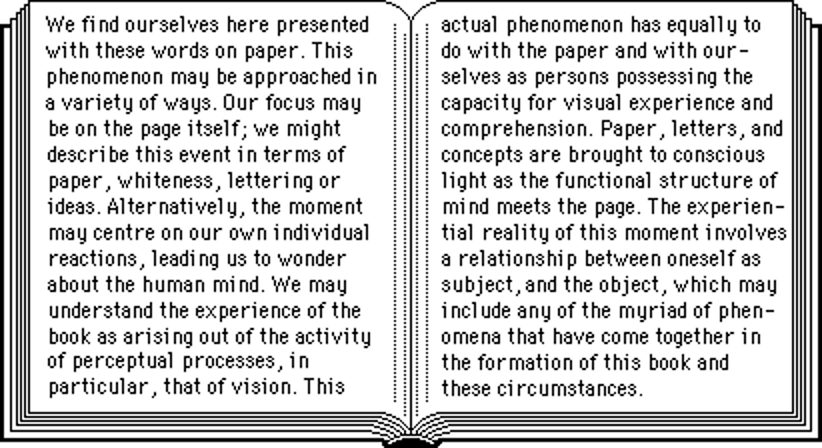
The page in front of me is white; it has a smooth texture and crackles between my fingers. It has a scent which reawakens past impressions of books, libraries and hours spent reading. The reality of this moment is a meaningful whole made up of such phenomena. Each is a manifestion of the relationship that exists between myself and this paper. The mental phenomena that I understand to be shaping this moment, are relational in character. Whatever this paper is, in being itself, it comes into existence as a perceptual, intellectual, cognitive and otherwise psychological event as I gaze upon it and contemplates its nature. While it exists with or without me, I cannot imagine its existence being a visual, auditory or tactile one without the sort of interaction that is here, currently taking place.
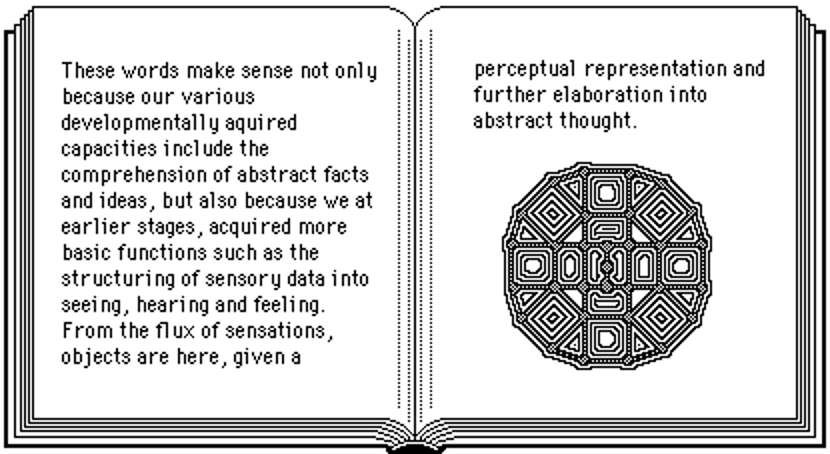
Consciousness may be organized around any number of foci. At one point the focus will be on an intellectual phenomenon: these words and the meaning they convey. At another, I will attend to a more spatial event such as the shapes of the letters. I notice that the letters exist as a contrast of dark on light. My attention turns to the smell of the ink, which reflects aspects of the substance and physical structure of the print. In attending to each of these, I capture some aspect of the law and structure which constitutes the world.
Through one’s relationship with the world, by focusing on and organizing those aspects that concern oneself, one participates in the genesis of each particular individual experience. Both thought and perception give shape to a universe of smells, sounds, feelings, sights and tastes, as perceiving entity that is the person explores her world. Intellectually she elaborates patterns, rules, principles and theories; through observation and the manipulation of variables, the person develops an understanding of otherwise hidden structure. The child approaches and manipulates objects in her environment. The adolescent student may speculate about the nature of paper, heat and carbon as she observes a burning match. Creation is illumined by mind.
The process is one that begins at conception with the diffentiation of the omnipotential fertilized egg into the various cell types and continues in the extra-uterine environment, the infant learning to recognize and distinguish objects and people. Through modelling and the acquisition of knowledge from societal representatives, the person develops the concepts and world views that reflect the culture into which she is born.
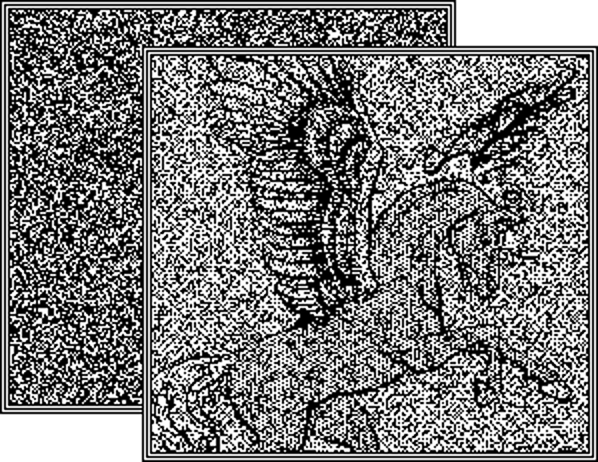
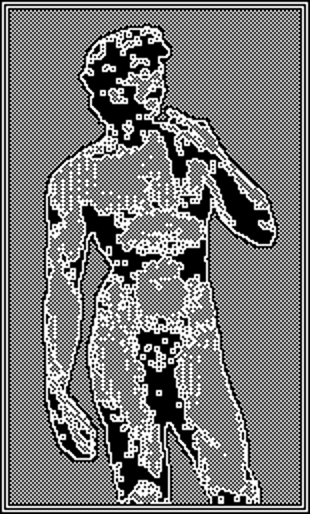
When faced with any situation, the mind attempts to mold the new reality into familiar patterns. It seeks structure and will introduce it even incorrectly until a truer understanding is found. This characteristic is useful in the understanding of mental structure. The introduction of an ambiguous or almost random structure reveals unconscious mental processes as they evoke self-generated experiences on what amounts to a blank screen. Where the structure is too vague to elicit universal responses, the person’s own individual concerns are the major shaping force giving rise to the experience. Presented with a random array of dots, for example, before its chaotic organization is understood, before we grasp that chance is the pattern, we may begin to see figures: bizarre, strange impressions which are aggregates of known bits and pieces. Combinations of past, internal and otherwise inappropriate forms emerge. This is the basis of projective tests such as the Rorschach, which can furnish an insight into the interests of the patient. The person sees in the equivocal figures that which is on her mind. In far away lands there live dragons, faeries and demons: perceptual forms projected from the world of the known. With understanding, the illusion fades, replaced by a new vision and paradoxically a deeper mystery.
A collection of what might otherwise be seen as small twisting and curving lines, here conveys meaning. Words are presented in the visually perceptible physical form of ink on cellulose and thereby communicate ideas and feeling. Our ability to ascertain their meaning has evolved through repeated contact with the written word. Initially a slow and cumbersome process requiring rote, reading now is likely to happen automatically. With practice and the acquisition of greater knowledge, one develops the capacity to quickly move across the page, line by line, recreating within oneself ideas and images evoked by the words.
We are herein witness to one of the essential mysteries of mental functioning: that this experience is one of meaning. We recognize the various elements that emerge out of the moment as a train of thought, a collection of words on paper, a book lying in one’s hands. Arriving at these observations from the multitude of possibilities, we are able to give them names. Once in possession of the name, we can be led back to the perceptual event and the concepts with which it is associated. The perception of these words is associated with certain understandings. These symbolic representations communicate meaning.
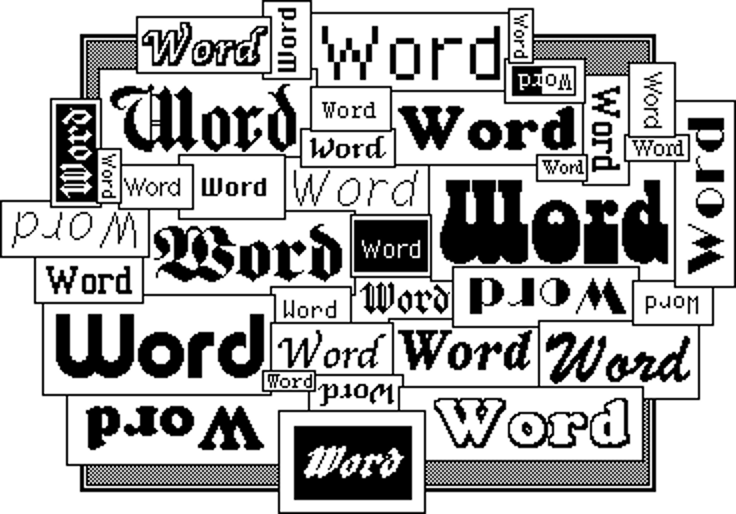
Letters, representing the various verbal sounds, are combined to impart meaning, visually. Each letter may be presented in a different or distorted way , but there seem to exist some essential qualities to the form of the letter and its context, that allow for its recognition and hence the transmission of the message. In the above illustration, for example, regardless of the way “WORD” is presented, one is able to perceive and understand it. Each letter may be expressed in different ways and the entire word may be shown in a variety of orientations and still maintain its ability to convey meaning. The appearance in itself, of the letters and words, in fact, allows for the additional communication feeling states. The quality ot the type can evoke different emotional qualities and associations that the reader might relate to certain attitudes, or to particular cultures, eras, and societies, or to specific methods of communication.
Comprehension and the communication of meaning necessarily involve learning and memory: the capacity to reproduce mentally, aspects of past experience. A particular fragrance may induce a series of feelings, visual impressions, thoughts and desires tied to particular situations and relationships. In such cases, one re-experiences states which are linked in thought to one another and to the aroma. There exist another form of memory which involves the accumulation of knowledge without any necessity of having to remember the actual lessons. To illustrate: I recall being asked to recite the “three-times” table in primary school. I remember feeling embarrassed as I fumbled about. Here is a memory which includes certain actions and feelings, and a visual impression of the room. Now, given two numbers there is an almost immediate association to their product. This takes place without having to refer back to the situation in which they were learned. Memory in some form, has a role in all mental process. It involves changes occurring with each new experience, resulting in the formation and retention of associations.
In order for comprehension to occur, there must first be an awareness of a particular phenomenon. One must detect the necessary components that will form the elements of the final understanding. This takes place via the sensory modalities and their extension through various techniques which transform the imperceptible into that which can be perceived. We can, for example, see and plot the positions of various stars. Constructing an apparatus such as a radiotelescope (which resonates with incoming electromagnetic waves and go on to produce audible and visible signals), we are able to cast our gaze further, to the limits of our universe. As our sight is amplified through electronic means, so to are our organizational capacities magnified, with the assistance of computer systems which manipulate variables and perform operations at previously unimaginable speeds. Thus, we are able to observe galaxies at the ends of the universe, measuring such properties as the frequency and intensity of the signal; these are then organized into a mental reconstruction of these celestial bodies in terms of their position, speed, size, age and energy production. Knowing the kind of information we want, we search for it and then proceed to develop a picture of that which we are trying to understand.
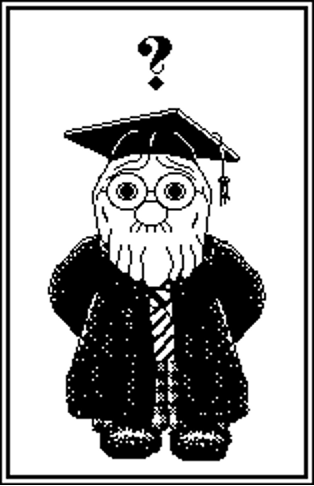
Comprehension involves, in addition to the detection of data related to the structure of a particular event or situation, the construction of models and concepts which organize that information. This process is essentially a whole of which perception and the abstraction are integral parts. While a specific understanding may be thought of as being determined by what is perceived of the world, it must also pre-exist in an embryonic form so that it may direct what is to be perceived. The discovery something in one’s environment must be accompanied by an idea of what it is that one is looking for. In order to observe and understand a particular phenomenon, one must, at the same time possess a framework defining what it is that one is seeking. In this light, knowledge is seen to be an essentially creative activity arising as an aspect of the relationship which is formed between the person and her world; it involves the discovery of previously hidden or unrecognized structure through the elaboration of concepts which go on to shape subsequent perceptions.

Once a particular understanding is evolved, it will continue to act as an organizing principle, making reality perceptually and cognitively known to the person. Because the intellect is limited and one cannot know everything, there cannot but be, misunderstanding. There is, in fact, without an appreciation of the tentative nature of intellectual functioning, only misunderstanding possible. At some point a conceptual framework may reveal itself to have a limited validity; the observed facts will be dissonant with the available explanations. Where discordant impressions arise, an initial response might be to attempt to force them into the old mold, or to perhaps simply deny their existence. In a creatively open relationship however, mind meets the challenge to form a new order incorporating and resolving the contradiction.
A child is told to go to bed by what she then sees as a dictatorial cruel ogre. A second ago and a minute later the monster is warm and cuddly mom. Which is the dream and which the reality. Ultimately both ego-centric views are superseded by one which sees the mother as an individual in her own right, having other agendas beyond those of nurturing and gratifying the child. Under such circumstances, one optimally is be able to abandon the previous perspective in search of one which more encompassing and coherent. One thereby grows in a process that sees a deepening of the relationship with the other through a heightened recognition of her separate identity.
This is not always easily done however, for what is being called into question, in such cases, is the validity of a relationship and the threat of aloneness. The appearance of previously unrecognized factors suggests a lack of connectedness that may shake one to one’s foundations.
Believing oneself to be loved by one’s spouse, one interprets the ups and downs of married life in a certain manner. A later revelation, betraying the possibility of there never having been any real love, casts the entire history of interactions, in a new disturbing light. Under such circumstances the loss involves not only one’s beloved, but one’s sense of oneself and one’s abilities to apprehend reality. Not surprisingly one is likely to fear the loss of one’s mind.
One solution lies in mistrust, beneath which continue the disappointed yearnings and the pain from which the person must shield herself. Another solution involves the denial of the disturbing new information. One attempts to maintain what has become a façade; yet there remains ever a nagging doubt. In either case one runs from uncertainty, loneliness and confusion, to something not quite solid but which must be vigorously upheld. One avoids the suffering and fear that comes with the confrontation with the abyss and thereby, denies oneself the opportunity of a creative expression which would bring about a new order and a firm basis in what is truly real.
This pattern of human growth and development is seen in a variety of human endeavors. The child gradually comes to see her mother as an individual whose motivations and existence are independent of her own. In our work, the dreams of youth are replaced by the solid reality of what we do. Relationships deepen with greater intimacy, as we pierce the fog of our wants and fears and gaze into the heart of another. Culturally, patterns of social interaction may be stable for centuries only to undergo, at other times (as we are today, witness), dramatic transformations which unleash fantastic creative and destructive energies, in the search for a new equilibrium. Intellectually, one finds that each theory supplants the previous one which has, at that point, become increasingly cumbersome in explaining the emerging facts. Though creative imagination, a new view of the world emerges as the ties to the old are abandonned and one ventures into uncertainty and ambiguity. In all these human activities there is a relationship which fails but is creatively and heroically, reestablished, but at a more profound and comprehensive level. That which was true of the old is expressed in a new way which reveals a deeper meaning.
Experiential phenomena emerge as part of the living paradoxical reality of the person-in-the-world. Perceptual processes are the means through which immediate contact is made with the environment. We see, hear, touch, smell, and taste the world about us and it thereby becomes a part of us. These perceptions do not exist apart from understanding; inseparable from the sensory experience are the cognitive processes which make it intelligible. The complex structuring of experience involves a linking of present to past. Changes occur with experience that live on as memory, influencing future experience. These processes of perception, thought and memory constitute aspects of what is essentially a loving relationship that sees the surrender of the erson’s awareness to that which is known; through them a universe which includes the person herself is brought to conscious life. Seeking her own particular form of active participation within the world, the person is manifested as a drama involving and transcending the individual experience which springs from her particular relationship with the circumstances into which she has been cast.
In search of truth.

Unity of Mind and Body
Human experience includes, in addition to perceptual phenomena and their intellectual elaboration, certain emotional qualities which are related to the significance that the particular situation holds for the individual. In trying to understand a person, whether it is oneself or another, one seeks not only descriptions of events and circumstances, but more importantly, their meaning as is revealed by the way in which the person felt about and reacted to her circumstances.
Meaning is central to human experience. Mental events, be they perceptions, thoughts or feelings, come organized into meaningful phenomena. The person is thereby able to communicate with the world. Describing her perceptions, ideas and emotions, the person conveys a sense of what her world is like. These messages recreate within the listener impressions that correspond to the initial experience.
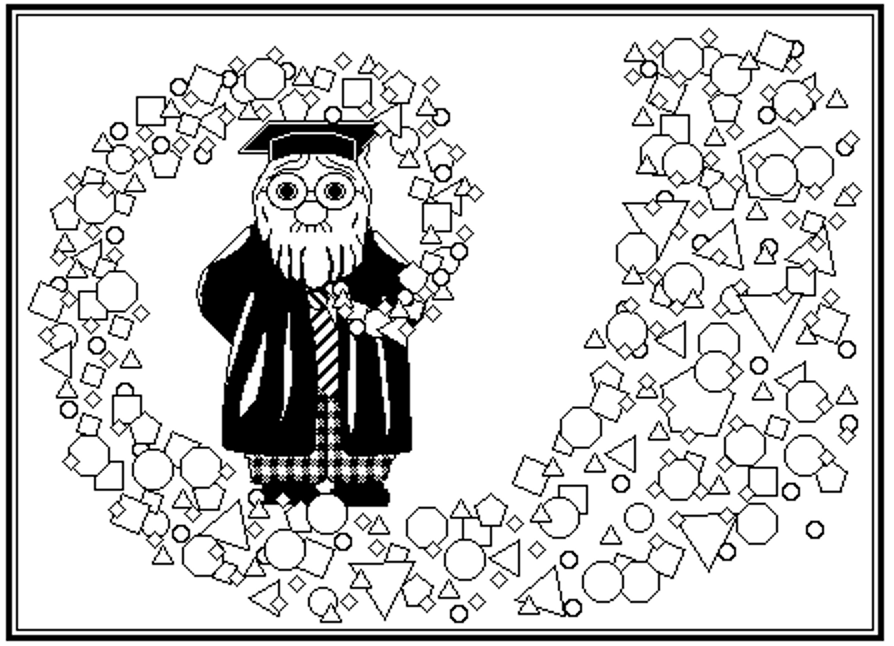
The material which a person presents us about her experience is interpreted thereby making her comprehensible as a psychologic being. One says one knows a person after one has developed an understanding of the recurrent ways in which that person views, thinks about and acts within the world. Her statements or behaviours are accorded particular meanings; where the meanings are unclear or discordant, further insights are sought which are then related to others. Though I read, speak, move my hands, I remain impenetrable darkness which my intellect cannot illumine. Theories and ideas are all very fine, but who and what am I really? How and why does this occur? The abyss surrounds me. We come to know another as her communications are made sense of as part of a coherent psychologic structure. As each part of the picture appears it serves to bring the whole to light which then shapes subsequent interpretations.
The Person as Instinctual Drives: Among the approaches one can take to arrive at an understanding of a person are those that focus on her wants, needs, conflicts and feelings. Exploring the patterns that unfold as she tells her story, one learns how the individual person views others and herself, and how in her relationships she expresses her hopes and fears. Her dealings with others, her self-image and emotions may be described in terms of an evolution of passions which have emerged from her earliest meetings with representatives of the world.
Psychoanalytic thought describes stages of psychosexual development in which libido, a postulated mental force related to the sexual instinct, undergoes a set of developmental stages following a variety of pathways. Sexual energy is associated with biological and psychological needs and its evolution is understood as proceeding from oral to anal to phallic to latency and then to genital phases.
The earliest extrauterine phase of development is called the oral stage because of the prominence of the mouth as a source of pleasure. Associated with the need to incorporate the physical sustenance necessary for life and growth, are sensations and wants having to do with the upper gastrointestinal tract. It is through the mouth that immediate contact is made with the world which takes shape experientially as a friendly, fulfilling and/or an inhospitable, withholding place. For the first eighteen months of life, the relationship between the infant and the mother is the overwhelmingly most important one for both parties. The relationship provides the child with the immediate care and nurturance that is necessary for both physical and emotional growth and serves as the basis from which personality and relational structures are formed. Through this first contact with the world, the person develops a sense of herself as being worthy of care and nurturance. Among the tasks associated with this stage are those involving the capacity to trust oneself and the other and dependency. A successful emergence through this phase results in and to give and take without excessive dependence, guilt, or envy.
The anal stage extends from about the first to the third year of extrauterine life and involves the child’s attempts to achieve independence and self-mastery. Physiologically, the child has matured to the point where she can control a variety of elements within and outside of herself. At this point the anus is a souce of pleasure as the child retains or expels feces. Feelings of shame and self-doubt are encountered along with those of pride and confidence; these rise and fall in accordance with the achievements, acceptance, praise, and criticism that is met in pursuing her goals. Optimally, through her encounters with success and failure, the person able to subsequently, better know, accept and affirm herself in cooperation with others.
During the phallic phase, libido becomes associated with the genitalia. Built on previous experience, this period plays a major role in gender identity and the development of predominantly genital sexuality. It is also seen as an important in terms of mastery over internal impulses. The mother-father-child triad evokes intense emotions; lustful possession, jealousy, and fear of reprisal, bring the child closer to the opposite sex parent and into competition with the one that is of the same sex. Identification with parental figures provides a heightened ability to deal with such powerful desires; the child incorporates the parent as superego or conscience. This process provides the child with an increasingly effective agency to direct “impulses” towards constructive ends.
Latency allows for further integration of the person’s sexual identity. Also, with the decline in “instinctual impulses”, there is a greater involvement with the world outside the family and a greater interest in the mastery of intellectual and motor skills. The child who has been, thusfar, relatively successful in meeting the challenges which were posed in her relationships at each stage, would show a sense of initiative and industry without the undue anxiety that would be associated with a fear of failure, defeat or inferiority.
The resolution of the final “genital” stage, in adolescence, sees a reintegration of wishes, fears and conflicts surrounding the previous psychosexual stages. At this point the teenager has a fairly consistent identity and a heightened capacity for self exploration, for satisfying productive activity and for relating to others.
There are needs associated with each developmental level; these needs may be contradictory and emotional conflict ensues. In situations where the conflict is not resolved, both drives continue to seek gratification. This is likely to happen unconsciously. The person is unaware that he is actually behaving in a certain manner; she does not understand the meaning of her behaviour. The roots of the neurosis are to be found in childhood. The person has been unable to arrive at a resolution of the conflict except through maneuvers which lead, however, to intra- and interpersonal difficulties from time to time. Ultimately, in those emotional areas which are involved with the conflict, the person fails to mature. The person does not surrender her childhood wishes which continue in a disguised manner. Because of this she is unable to emotionally move on.
The central feature of neurosis is conflict. Eros versus Thanatos: the universal drive toward life comes up against that of death. The search for pleasure and avoidance of pain meets reality. Rather than being resolved, it is driven into unconsciousness thus allowing both drives to seek gratification in symbolic form.

We seek union with certain aspects of the world about us and wish to separate from others. Desired union and successful separation are experiences in which we feel whole, satisfied and happy. Forced unwanted union or separation is unpleasant and painful. Where the creation of the desired reality seems impossible but its loss too dear, there is an attempt to stave off the unwanted reality through flights of fancy. Neurotic symptoms are unconscious fantasies expressed in coded form.
One way to gratify childhood desires can be understood as involving the “defense mechanism” of sublimation. Primitive wants are “defended against” and expressed indirectly in socially and personally acceptable ways. A simplistic example might be one in which the choice of medicine as a carrer in an individual with ambivalent feelings towards others may be understood as a means of gratifying both erotic and aggressive wishes through a relationship that provides close physical contact and the
opportunity to help while witnessing patients’ suffering. In this light, the actions of this particular doctor would be viewed as brute passions, thinly disguised in the civilized image of a benevolent physician. Sublimation is here seen as a specific maneuver which the person attempts in order to derive some gratification for yearnings which she cannot bear to abandon. The person in this situation however, has paradoxically long given up on fulfilling them. These wants continue on with only partial gratification and in disguised form.
The yearnings that underlie the life that we create for ourselves are clearly not fabricated by our intellect. They emerge from deep within us, seeking, in fact, demanding expression. It is not so much that they are irrational or primitive or brutish. (The ugliness comes more as a product of their frustration and the resultant aggressive impulses that develop to assist in overcoming that which separates us from the beloved.) The wants and needs which underlie the person may be understood as being analogous to the omnipotential single-cell fertilized egg developing through stages of human existence; the task in life is then, not so much a refinement or redirection of these yearnings from their original aims, but rather the discovery and creation of rational objects to give them fulfillment. It is the failure to abandon unsatisfying early “objects” that is behind the particular person’s use of “sublimation” in her dealings with others.
Love is not merely “sublimation”. All may be vanity; yet it remains possible to act lovingly in spite of this. Though interesting and in many ways self-serving to speculate otherwise, civilization and decency in social interaction does not rest on a predominantly neurotic basis. The expression of love for one’s neighbour need not be rooted in childhood conflict. Surrendering childish desire, the person gains in personal power and is better able to understand her neighbour. To love at this point is not an attempt to placate some threatening parental ghost but is rather, an act of choice which is now spontaneous given. One’s shared humanity with the other is recognized. The person is able to truly love her neighbour as herself because the jealousy, envy and narcissism that come with frustration have been left behind, and not out of a paradoxical attempt to gratify these impulses. Without a maturational change, without the ability to forgo gratification and set aside one’s narcissism, it is impossible to love one’s neighbour as oneself. Paradoxically love is found through the failure in meeting the imperative to love. The realization that one cannot overcome pride, that in this regard, one is powerless and guilty, consumes pride and thereby frees the individual allowing her to tune in to the other; thus true love replaces the feigned attempts at moral superiority.
The Person-in-the-World: I and the Other: Imagining experience as being comprised of structures of meaning, we may conceive of that make up the person, most is a sense of “I” plays a central role in the experiential drama . Found universally, it is experienced in different forms within and among individuals. This “I”, this “me” and what is felt as “mine” involve a complex set of experiences derived from interactions with others. Ultimately, it is rooted in the spiritual reality of the person’s being an individual participant in the world. The person exists in relation to the other and comes to know herself as a separate psychological entity through her communication with others. The person’s self-image is derived from the experience of being with other persons. Self image, the sense of “I”, is not something static but is in a state of continuous transformation. One perpetually enters into relationships with wishes, hopes and fears which are in turn modified by the results of the interaction. The manner in which these are expressed, how they are interpreted and reacted to by the other and how the person understands the response of the other determines the view the person has of herself. Desire, then, is a key factor in the sense of “I” that develops. The desire for life, integration, human contact, pleasurable experience and the avoidance of painful one’s, the desire for success, sex and so on spurs one on to interact and to learn the physical and social rules. Based on one’s relations with the objects of one’s desires, a view of “I-in-the-world” is elaborated. Based on one’s actions, that “I” is moulded into who she is, which in turn shapes the sense of “I” which again affects one’s actions, and so on. All the while however, one’s essential nature, one’s being, the reality of one’s creative participation in the world remains unchanged.
The person is a manifestation of being; a manifestation that is a psycho-physiological whole with the world in which the person participates. Psychological development begins at conception and proceeds as a continual elaboration of patterns of experiential structure. This developmental process is comprised of a series of tasks involving relationships with the world and significant persons who may facilitate or obstruct the persons growth. Psychological maturation involves changes in a number of areas including: the view one has of oneself, the needs and wishes that one holds and the gradual accumulation of personal power. The infant develops a sense of herself as distinct from the mother-world through ongoing interactions involving physical and psychological nurturance. The hunger for the breast, the anxiety and spasmodic cries bring relief from that which is beyond one’s conscious sphere. Depending on the response of the caregiver to the child’s activity, particular patterns of behaviour and attitudes towards others are established.
Deprivation, for example, may evoke feelings of intense powerlessness and aggression which would lay the ground for ongoing conflicts over separation and hence undermine the persons effectiveness in those situations that imply a separation. The depriving mother would be experienced ambivalently as a “good” nurturing goddess and a “bad” withholding or rejecting witch. The view of herself that would accompany this, would be an equally ambiguous one of either utter worthlessness or of being supremely entitled and having been monumentally wronged. In such cases, the child would want, in effect, to destroy the very thing she wished for most. The relationship may be so confusing, the emotions so intense and the stakes so high that the situation is intolerable. Unable to integrate these views of the mother, she would continue to have difficulty in her experience of others as complete persons. People would continue to be experienced as either all-good or all-bad. The person would use these same structures when reflecting on herself. There is no real sense of the other, nor of herself as person. With a failure in the attempt to make the parent attend to her needs, the child may retreat in a variety of possibly self-defeating directions. The maladaptive behaviour patterns that develop would tend to re-enact the primary relationship, thereby reinforcing the destructive experiential structure and perpetuating the problem.
In some cases, the child may distance herself emotionally or develop an accommodating, but false set of expressed desires in order to maintain the needed tie with caregivers who, being needy themselves, are unresponsive to her particular needs. Once such a pattern of expectations and responses is established, its impact is felt throughout the continuing path of development. Growth would likely be met with resistance since differentiation of self from other requires a stepping away from an existing state of affairs and would therefore reactivate seemingly insurmountable anxiety. The passions of the primary relationship emerge within new contexts as a repetition of the past is feared.
The person flowers in the light of parental love. Her creativity blossoms with the recognition and affirmation of her unique qualities. The more the parents have a stable and coherent sense of themselves and others, the more they are able to act unmotivated by considerations of what the other can get out of the relationship, the greater these attributes, the more they will be able to hear and appreciate their children. Where such qualities are scarce, whether it is manifested as neglect or as an overinvolvement in which the parent seeks fulfillment though the child, there exists a lack of contact, of awareness of what matters to the child, of what constitutes her essential needs. Dependency and symbiosis ensue as the growth is stifled and the boundaries between parent and child are denied. Though providing some degree of security in the face of developmental arrest, eventually these symbiotic relationships falter with much guilt and resentment as each participant, seeking personal self-fulfillment through the other, is unable and unwilling to give in the absence of support from the other.
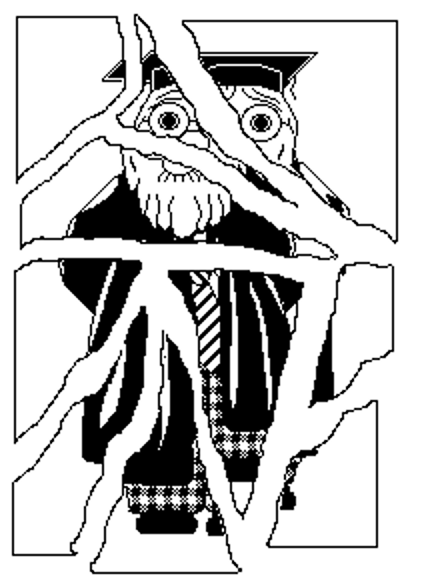
Whatever the circumstances that one is born into, the fact of one’s existential position remains; one has to come to terms with the possibility of death, guilt, and loss of purpose. Though persons differ with respect to their exposure to situations that bring to light these aspects of the human condition, they are universal ever-present realities. The awareness of these possibilities emerges with the full force of anxiety and despair whenever one is met with a failure in a sustaining other. The particular relationship may no longer provide affirmation of who one is and one is left feeling misunderstood, different, strange. Alternatively, the relationship may fail to provide what was a figure from whom one could draw on, for strength. A fragmented, regressive state ensues; what held the person together, what provided her with a sense of wholeness is now felt to be illusory, or something that is being maliciously withheld and denied by the now all-important other. The experience may be overwhelming and one’s courage may be insufficient to meet the threat to one’ psychological integrity; in such situations, it is likely that a retreat into psychopathological forms of coping will be attempted.
Such experiences, however, are a natural part of life, prodding the person on to greater maturity. Occurring in small increments the confrontation with her limits allows the person the opportunity to overcome her condition in reality. She comes to a growing awareness of herself and is able to take control of her life and thereby gain in terms of personal power. The person, gradually, is able to see the other, not as a mirror providing her with an image of herself, nor as a source of power and direction, not even as a twin who enables her to love and accept herself. As she matures, the person comes to a recognition of her existential aloneness. The person increasingly is able to be herself not as an image or a role, not living on borrowed strength and love; the person thus creates herself in confronting her nonbeing and becoming the truth of her own will. Coming to realizations about herself, the person becomes who she is in the exercise of her will.
The process of maturation involves the development of a greater self-reliance. The growth of personal power accompanies a move away from dependent relationships and a capacity to relate to the other as person. This occurs as one is thrown back onto oneself, as one is confronted with situations in which one must act in order to bring about a desired state of affairs. What was provided by others may be no longer forthcoming; others may not have the ability or desire to create the wanted situation. Out of the darkness, in the confrontation with one’s nonbeing, one creates oneself in the act of bringing about the new state of affairs. In the creative act of will the person brings herself into the world.
The Unconscious: Just as with the physical dimension of the person-in-the-world, where an infinitely complex series of material events are involved in the production of each moment, there are patterns of mental functioning which are not available to reason. Each action, thought or feeling is the product of a complex network of meanings which involves the totality of the person and stretches back beyond her birth and out into her family, community and the world in its entirety. An action affects the other who in turn is changed by that interaction and who then goes on to affect others. Just as all particles in the universe exert some influence on all others, persons reverberate to each other’s actions. The person is clearly unaware of the myriad of events that have come to play in even the most trivial of experiences.
Included in the unconscious are elements that we actively do not wish to acknowledge. In the service of self-preservation, at early stages of emotional development, dangerous and unacceptable ideas, impulses, and feelings were dealt with in such a way as to prevent them from becoming conscious. Remaining unconscious, these childish wishes and fears are unable to mature; they remain untouched by experience and continue to seek their infantile aims. According to the Psychoanalytic topographic model, therapy permits growth by rendering the unconscious, conscious.
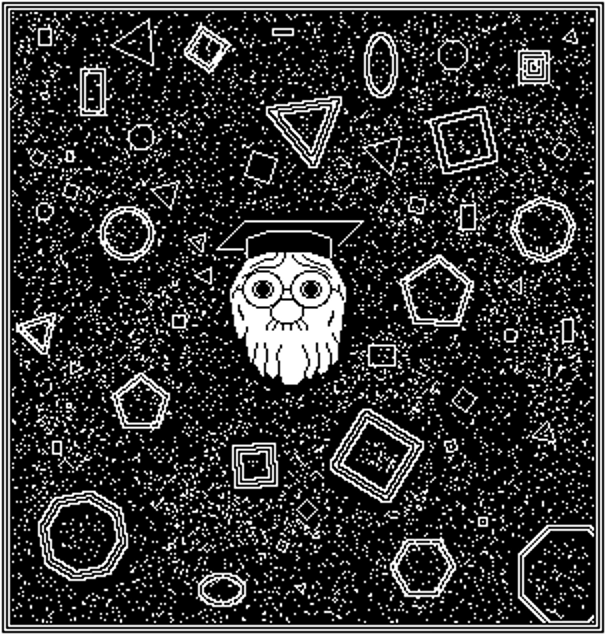
One’s perceptions and actions are determined by factors that are not immediately evident to one’s rational mind. There is an unconscious aspect to the mind. At this moment one may have a series of opinions regarding this statement. What one thinks of the idea of the unconscious and other concepts does not exist as a static reality but rather emerges as a series of associations. One realizes how one feels about a subject by contemplation. One comes to know one’s thoughts, attitudes, and reactions toward given phenomena by allowing oneself the opportunity to ponder them. The reality of oneself is revealed as one (acts/thinks/?) in the world.
Will, Being, and Love: The fact that we can question our motives implies firstly, that there is an aspect to the person that is the will, and, secondly, that this aspect is not be readily understood. Mental events have meaning and purpose. The will underlies the acts by which these meanings and purposes are brought into existence. The will that shapes the person can be understood by what the person brings into being. The will seeks to express a potential; the person’s essential feature is that of being a prerational will which is a part of the process of creation. Having said that the pattern of the person’s mental life is unconscious, it should be pointed out that the will is ultimately always a matter of conscious choice;{ though one may choose how to act in a situation, the mind that decides cannot decide what the choices and desires will be.} Desire and reason optimally act hand in hand; at times the desire may be so difficult to express that the activity of either may be suspended. Choice points to what is fundamental to the person: her will Will creates her through the attributes that make the person, human. It acts, through intellect, speech, muscular activity, and so on. The person is the meaning and purpose of the particular acts, thoughts and feelings that combine to make up the totality of her life. This aspect is unconscious because of one’s complete engrossment with whatever is transpiring. The person is the pattern and in order to become aware of herself there must be a separation from herself. One must examine one’s thoughts for patterns in order to get a sense of their meaning. As long as one is absorbed with the ruminations one cannot transcend them.
The Basis of Unconscious – separation of being; only aware of one aspect of the pattern, pattern is an intellectual event requiring CNS in the world, patterns beyond the one that presents on the surface; just like physical phenomena; beingness lies in the actuality of what is occurring – cannot say what that would be; to analyze, look for patterns is not to reintegrate though conversely, to reintegrate is to gain an understanding of one’s motives.
each awaiting the appropriate circumstances to become manifest and combining with the others in each moment, to produce the resultant experience and action. Just like events in the external world the person exists as a mystery to herself, a mystery which is revealed in the creative expression of herself in relation to the world.
The person-in-the-world may be thought of as a continuum stretching between the two poles of individual and cosmic will. Arising out of the void is the world which is in turn perceived by the person. At one end we would have the will that shapes the world outside of the person and at the other, would be that will which decides her individual existence. Ultimately these are one; and thus the spectrum would be circular. The pole of universal will is that which is described as fate or the laws of nature. Both are unconscious in the sense of their being a void of infinite possibility. this perception is guided by thought which has developed from genetically based intrinsic ways of understanding. Associations develop out of experience and allow for the formation of sensory images. These thoughts which have perception on the one end which reaches out into the outer world, have at the other systems of meaning linked in turn to the basic wants that ultimately create the person through the exercise of her will.
Next Page
 Louis Canella, M.D.