
The universe can be understood as being generated out of the eternal Now. Creation has an order which can be comprehended rationally as individual events and universal principles. The order which is this paper is the particular form that being has taken in this instance. Unlike nonliving matter, the person is a being who participates in her creation through the exercise of her will; she has the finite freedom to become the person she wills given a set of life circumstances and challenges. The living person has an order or structure which forms a pluripotential basis from which she can create any number of lives. When we examine a person’s past, we are looking at what has passed away and therefore see a fully determined being, shaped by physical and psychological forces; the living person can choose the path his future life will take. The reality of the person’s being a psychophysiological structure leaves her open to suffering. Because the person is structure, she is therefore transient and finite. Nonbeing is an integral part of the person; the boundaries, which may be felt as threatening and restrictive, are in fact, the very structure that is the person. In a creative universe nothing is constant save creation; to the finite mind the process appears a destructive one since it ultimately means that all that now constitutes creation will ultimately be no more.
Because nonbeing defines her, the person’s life is characterized by suffering. Suffering, in this light, is a spiritual phenomenon having physical and psychological aspects. Pain is necessary in order to gain an appreciation of and deal with what is harmful to the psychophysiological structure that is the person. Pain takes on an emotional component as its meaning is elaborated. Anxiety is interwoven with the sensation that signals structural damage. The anxiety is that there is something serious happening, something that may mean lasting damage. The anxiety is a warning that a state of despair is at hand. Despair arises when there is a loss of something that is loved. The beloved may involve another person, a physical ability, an ideal, a self-image, or oneself in one’s entirety; swallowed by time, it’s absence leaves the present empty, hopeless. Human existence, seen through the eyes of despair, is a pointless tragedy in which the individual is ultimately robbed of all she possesses, including her own existence.
Suffering arises in states of sickness; the person finds herself out of harmony with the world and the ground of her being. Healing reestablishes the wholeness of the person-in-the-world. Healing, though it may involve any of the aspects which are the person, essentially is a spiritual process in that it brings the person to a new, deeper relationship with the ground of being.
Physical Sickness.
The person exists as a manifestation of physical structure. The individual’s structure can become disharmonious in itself and in relation to the rest; there may be disruptions due to a loss of function or the intrusion of noxious elements. Psychiatrically speaking, the impact of physical illness lies not only in the direct effect on the brain but also its psychological and social consequences.
From the person’s earliest moments, she is vulnerable. In utero the developmental process is influenced by genetic and external factors. Variations in the DNA code may not allow for the normal structure and metabolism that is required for the development of one’s faculties. Mental retardation, as an example, results from the inclusion of an extra arm of chromosome 21. Infections, poor nutrition and toxins such as alcohol are other congenital causes of mental disorder. Physical sickness- toxins, infectious, neoplasms, metabolic/ endocrine, trauma, vascular, degenerative, allergic. Difficulty fitting in society- supports- abnormality-> disability-> handicap. – relationships -> self-esteem. Problem to find fulfillment – how to carry on. Psychiatric illness- schizophrenia, M.R., Affective Disorders, Substance Abuse etc. from notes to medical students.
Psychological Sickness.
(Notes to Medical Students.)
There is also a shift in emphasis from the past to the present and from understanding to action. Though one’s alienation developed at different points in the past, the dilemma is current; this is the moment in which one determines and carries out one’s future course.
Neurotic anxiety, we understand as a signal of unconscious conflict. What this means is that we are free, that we can act in any manner. The rigid patterns need not be adhered to. These patterns, this character armour was conditioned and continues to operate in an attempt to avoid anxiety, the awareness of finitude, and the possibility of despair. Neurotic anxiety is psychopathological in that it is, as Freud stated, a private suffering. Anxiety in neurosis can be seen as existential anxiety which has been associated with an idea, memory, situation or object in order to have something which the person can control or avoid and thereby continue to otherwise function as normally as possible. One is able to avoid despair by manipulating its symbolic representation. At the point that the patient comes to us, the patient is acutely aware that her strategies have failed; somethging is not right. Nonbeing threatens and the result is neurotic and characterological symptomatology.
Anxiety as a state in which we are faced with our finitude, manifests itself in three forms: the first, perhaps foremost, is the anxiety of death; the second is related to our will, our actions, and is an anxiety associated with the possibility of final condemnation; thirdly is the anxiety that emerges when a sense of meaning to our lives is threatened.
It is said that the repetition compulsion is an attempt to achieve a new end to a personal drama. In life however the only end it seems is death; all is a continual transformation. Pleasure becomes empty or is lost, success meaningless or transient at best. One attains a positive and is inevitably, eventually met with its negative – again and again.
In Freud’s words, Man “strives for pleasure . . . an absence of pain and unpleasure and . . . the experiencing of strong feelings of pleasure . . . We are so made that we can derive intense enjoyment only from a contrast and very little from a state of things . . . We are threatened with suffering from three directions: from our own body, which is doomed to decay and dissolution and which cannot even do without pain and anxiety as warning signals: from the external world which may rage against us with overwhelming and merciless forces of destruction, and finally from our relations with other men.” He also wrote, “In the last analysis, all suffering is nothing else than a sensation; it only exists in so far as we feel it, and we feel it in consequence of certain ways in which our organism is regulated.” Though asserting that suffering is nothing but a sensation, as would be pleasure, suicide is not included by him as an option, not even perhaps a poor one, for the individual. Does it matter? In responding to this question posed to us by Life, one leaves the biological and the philosophical in that the answer is found neither empirically nor through logical reasoning alone: one’s life’s meaning is created deep in one’s heart, where suffering, the hunger and aching is the dark side of the desire that ultimately creates and is this individual “me”.
Suffering and the Human Condition.
Suffering is seen as central to human existence by all the major religions. The Buddha listed three signs of being, three characteristics that apply to everything in the natural order. The first is impermanence; the second, the absence of a permanent soul; and the third, suffering. That life is suffering is the first Nobel Truth of Buddhism. In one’s life one is met with illness and decrepitude. One must endure separation from what one loves and being tied to that which one abhors. However rich, pleasurable and filled with achievement one’s life might be, there is also loneliness, guilt, and meaninglessness. The root of the problem is seen as desire which drives us from our true centre. It is not that pleasure, wealth, fame, and power are to be avoided as necessarily evil. It is usually disappointment or envy that leads to such an attitude. The problem with them is that they are transient and once gone, it is as if they never were really there.
In the Hindu tradition one finds described a hierarchy of wants., The desire for pleasure forms the lowest level. The next is that of success which can be a source of fulfillment though one’s life be bare of pleasure. Both however are finite goods; one cannot maintain a steady state of sensual delight; and there is always someone wealthier and more famous, more powerful. Then too there are others vying for one’s position. One cannot even rets on one’s laurels; it seems that one of the first questions asked of Nobel Prize winners is typically what they plan next. Beyond these two wants, one finds the satisfaction of duty. One’s desire is that of assisting and contributing to others. This progression of wants can be seen as involving a decreasing reliance on things that come and go, for satisfaction and an increasing consciousness of the other. But even though one might seemingly work miracles in aiding others, here too one does not meet that for which one ultimately yearns. What we want, what really lies at the basis of all desire , be it pleasure, success or duty, is God. We want joy, awareness, and creativity, and we want it in infinite proportion. We seek our eternal home, Nirvana.
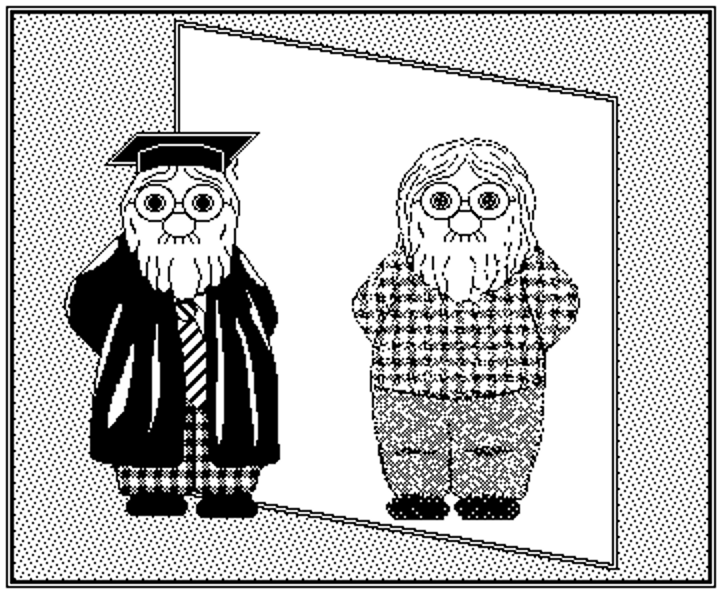
(Why suffering and despair?)
As a strict adherence to a metaphysical perspective keeps one from the living truth, so too one can lose oneself in illusion, clinging to religious symbols while one’s real intent is away from God. It seems inevitable that seeking one’s private ends, one will ultimately be led to atheism. The relationship between oneself and Reality is subtly and progressively transformed. The glorious vision of love that emerges from the meeting of the eternal with the finite, slowly takes on the appearance of its opposite: Satan. God is seen as out there, all powerful, demanding to be worshipped and loved; He is an irrational tyrant who tortures Job for a wager, destroys countless lives in a flood and does not allow us even the simple pleasure of masturbation without condemning us to eternal perdition. Who would not rebel against such a state of things; it is the only courageous thing to do. But then one finds that this god has feet of clay; the world becomes empty. It is a frustrating, dangerous, and painful place that no sentinent being would create. A god would not subject us to this; at least let us hope not. Partly through reason, partly through “wish fulfillment” one comes to see God as impersonal and then as a useless concept having which is solely an expression of people’s hopes and fears. The world is blind and indifferent, a collection of things: rocks, plants, organisms. Prayer within this framework is seen as a compulsive act designed to pacify the naggings of an irrational introjected set of rules and standards. In this world of limited resources, where one must toil and compete to fulfill one’s wants and needs as much one can, religion is seen as an opiate which promises gratification through the external intervention of a higher power while mankind continues to wallow in its miserable state. To Freud, religion was “patently infantile”, “foreign to reality”. He found it “painful to think that the great majority of mortals will never be able to rise above this view of life.” It is seen as a “universal obsessional neurosis which is derived from the infant’s helplessness and longing for the father.” Man is viewed as an isolated creature thrown into and pushed out of a dark and hostile universe in which he is but a plaything of powerful, irrational forces with only the lamp of reason to illuminate the way. One may concur with Freud that, “life, as we find it, is too hard for us; it brings us too many pains and disappointments and impossible tasks.” This latter view of man’s fate seems to lie along a continuum which has at its other end, the image of creation as being the product of a benevolent father. They seem all equally real and united in the idea of man as separate from the cosmos. What is in essence a totality becomes split resulting in an interdependence between the individual and his environment. Since he is not self-generating, man falls into a dependent position to the rest. Being dependent, he is either the cherished and loved offspring or the lost and lonely, impotent orphan. Repeatedly one is cast into this latter role as life makes all too clear one’s finitude, as one grows.
What is life? What are these pains and disappointments all about? What is this task and who is the taskmaster but who we really are? Metaphysically, the human predicament is seen as consequent to the total commitment and identification of the eternal Self with the life of the ego. Freud hypothesized that an “oceanic feeling” was a regression to a state of infantile narcissism in which the ego, id, and world were merged. It is supposed that there is a feeling of wholeness which is gradually lost as the individual develops a sense of himself as apart from the world and his own wants. This memory, because of its sense of unity and wholeness, would constitutes the source of religious feeling. It is easy to imagine, for example, how the garden of Eden might be symbolic of intrauterine life. Yet though one’s life becomes highly structured, containing vast numbers of things, processes and personalities in addition to a sense of “I”. it cannot but remain whole. Though molded into extremely complex patterns, consciousness remains ever pure, ever one.
Ultimately it is desire that creates and drives us down this continuum, from a benevolent cosmos to an indifferent competitive world. It is Eros, the want of and need to incorporate the loved object, the wish for union that paradoxically leads to a deepening state of separation, that results in an isolated ego, exchanging economic and instinctual satisfactions with other egos. Meeting frustration, desire leads to the construction of an increasingly fortified, potent ego. The greater the sense of separation, the greater the erotic drive. Frustrated, one feels oneself ever more compelled to force the world into the pattern of one’s wish, ultimately driven to the choice of resorting to violence and coercion. One’s view of the world varies according to one’s wants and needs and the degree to which they are fulfilled. As one matures, one finds oneself meeting increasing responsibilities in advancing to one’s particular destiny. No sooner is a hurdle surmounted than another appears. At times the frustration is overwhelming and one finds oneself naturally wishing the whole thing away. Would that some external agency could intervene on one’s behalf. One realizes however, that one’s life tasks are not to be solved by a sort of cosmic bellhop acting on them externally to oneself. Rather, there is a growing awareness of oneself as an expression of the eternal; as the manifestation of God’s will. We are a part of that infinite creative power, having the freedom in choosing the direction that our lives will take. Faced with the gas furnace of the concentration camp, one here too remains free, if only in choosing the attitude with which he will die, deciding whether or not, in one’s life the final victory will be love, courage, faith or otherwise.
Using a metaphor from Christianity, one is Adam, seated within the garden of eternity, coming to consciousness as he sets his will against that of God. Separated from the totality, the sense of joy that springs from participation in eternal creation and self-sacrifice is lost. One grows ever aware of one’s aloneness and finitude. One is unable to return and can do little else but push forward. In a condition of increasing separation, what was once a state of mutual surrender with the world becomes a barrenness and obligation. One is seemingly given nothing but asked to do everything. In the act of surrender and acceptance, one is with Christ,united with that whereby the universe emerges, is maintained, and perishes.
Positivistic man is the fallen Adam: he is trapped in a spiritual Oedipus complex> He chooses the way preferred by Freud, that of “becoming a member of the human community, and, with the help of technique guided by science, going to the attack of nature and subjecting her to the human will.” The sons conspire and, doing away with the heavenly Father, proceed to ravage their Holy Mother.
In the words of Lao Tzu: “The mighty Way declined among the folk And then came kindness and morality. When wisdom and intelligence appeared, They brought with them great hypocrisy. The six relations were no more at peace, So codes were made to regulate our homes. The fatherland grew dark, confused by strife Official loyalty became the style.”
From purity we fall into a state of increasing separation. We come to know who and what we are as we separate from the world, from actions, and ultimately from our thoughts and feelings: “I and the world.” “I do.” “I feel.” “I think.” Accompanying this sense of separation are dread, shame, and guilt.
Guilt is felt as a discomfort, an anxiety in being who one is apart from He who is boundless compassion. Psychologically one is castrated; that which was oneself in an unconscious condition, is now something “in there” which can be possessed or lost and which can possess oneself. In everyday terms, one loses confidence; one wonders if one is thinking and acting as one should.
Life comes to consciousness through separation. Finding that what was loved earlier is now feared or detested, one comes to see oneself as having desires, urges, instincts, wants and needs which act on this mysterious self. Along with this comes a sense of inadequacy because one measures up neither in love, which is symbolically represented as the smallness of one’s genitalia, nor in potency, the ability to do away with the barriers that keep one from the beloved. Depending on oneself and the circumstances, what in religion is termed grace, one may be reunited within a new state of things. Otherwise one might seek escape from guilt.
So one searches for rules, loop-holes, looking for righteousness, to shore up this feeling of a failing self. One strives for security by bolstering oneself with self-gratification or conversely by redirecting hostility from others onto oneself. It is all pretense, the uneasiness accompanying the lack of wholeness remains. The ego’s inner core of guilt remains even though endless and more elaborate rules are developed and in spite of the individual’s attempts to understand how he is seeking to placate and earn the praise of an imaginary parent. Appealing to primal patricide or psychosexual stages might redirect the discomfort but just as adherence to the Law will not return one to a previous state of things, the abolition of the Law does not bring about its transcendence.
To summarize what has been discussed thus far: Religion and metaphysics were defined and seen as two approaches to absolute reality which can be thought of as one’s inner-most Self which is at the same time the external God. Eternity was described as that which is immutable and timeless. It is a fount of joy and creation, represented within the human experience by divine symbols. In an inevitable search for particular satisfactions and in a prideful response to frustrations, one turns to the finite (*?what about the converse?*), separating oneself from the Totality with which is now in opposition. The relationship between oneself and the Ground of Being is transformed as is represented in the images one uses to relate to it. One becomes increasingly guilty and God’s presence is felt as an overwhelming silence. In the act of surrender, the love of God is revealed: the Self surrenders its identification with the ego and awakens to its eternity.
Though God is to be found within oneself, one remains a creature, a part of the finite world which constitutes everything we perceive, imagine, and think, and includes even our human soul. It is a world of opposites: being and nonbeing, truth and lies, good and evil, figure and background. Taoists refer to this as Yin and Yang; these opposites complement and counterbalance each other; they imply and are contained in one another. Though good and evil come together and are contained in one another they are as real as is all creation. Life however is a revolving wheel where everything leads to its opposite; it spins round until it knows that it is centred where all is a blissful unity.
Because we are expressions of and centred on the eternal Now of Being with which we unconsciously identify, we have a sense that time passes while we remain still. You may look at the clock and find that you’ve spent the last hour or so reading. There is a sense that the time has gone while you were sitting taking in and thinking about these words. Time is not really external to us however. The person is a historic being; she exists at a particular time. In fact the person or collection of persons is the actual time in history. Our actions, our being at a certain moment in the context of the past and future defines that historic moment.The person is a condition of transformation, of becoming. Nonbeing then is withus not only in projected form as an ever-present and unavoidable possibility, but in every act and in the surrender of each moment to the next.

Though the person makes himself whom he becomes, he does so only in a finite way; he does not generate himself in relation to the larger whole on which he continues to depend for both physical and emotional nurturance. Necessity makes us eternal children, dependent on family, friends, society, and the larger universe. The anxiety of death would include not only the eventual demise which our aging process relentlessly pursues, but also the weak and dependent position that we are in and which puts us at the mercy of the fates and other people.
Separation is the source of anxiety and despair, the demons and monsters that guard the gates to one another and ourselves. Anxiety and despair arise from the encounter with nonbeing. We become anxious and afraid when faced with the possibility of losing something we love, something which is a source of meaning be it a person, a position or role, an object, or parts of ourselves such as our minds, our capacities to act effectively, or especially ourselves in our entirety. When the possibility of loss becomes reality, when we are brought face to face with the reality of separation from the beloved, we enter into the state of despair. Anxiety and despair involve us totally. Emotionally, we are in turmoil, in pain; things are confused; we want to retreat. Physically, our hearts race; we breathe heavily. There is on cure to anxiety in the sense that if we balance the chemistry or the psychic forces, the source of anxiety will be abolished. What there is , is the challenge of heroic action. It is when our attempts have all failed, when the possibility becomes reality, that we enter into a state of despair. We have reached our limits; we are vanquished. Nonbeing is victorious. Helpless, we see the days stretch ahead empty. With the loss of the loved object, one’s ties to the world are cut; other loves cannot lift the emotional weight of one’s existential aloneness. One longs to die but can’t. As long as reason is intact, suicide is no option. It offers no victory over the fates that have driven one to this point. There is no victory over death, no escape from guilt. To bring about one’s own death is to merely hurt others, there is not even the satisfaction of a last heroic act of rebellion against God. Suicide is madness; there is no escape. This is the existential reality of despair whose approach is signaled by anxiety. These are conditions of spiritual malaise which the person becomes as he is confronted by his finitude.
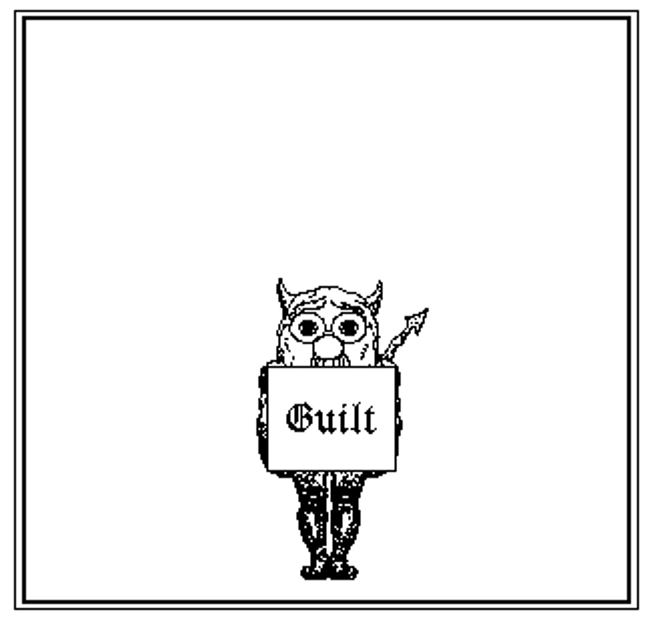
The anxiety of guilt can be seen as an offshoot of the anxiety of death in that the person’s actions may have consequences leading to her annihilation. It is not only the fates that determine the course of a person’s life but also her decisions, her actions. It is through the person’s actions that she becomes who she is. The peron is her life; this is the only life that person can have. Will she be able to create a life with meaning or one which she would rather have not lived? The burden of the universe is on one’s shoulders. There is more at stake than deciding on the validity of a value, it is one’s own concrete existence that is on the line.
Because life is concrete, because it is real, one may find at times that one is called upon to go against the universal norm. Life can be profoundly ambiguous, especially in those situations that matter most. In such circumstances one is never sure wether one is choosing for life and fulfillment or succumbing to some destructive influence. One may be compelled at times, in full appreciation of the ethical choice, to make an exception. There are times when rival goods make any choice result in evil. There may be so much to lose and one’s motivations so unclear that one is forced out of one’s ethical system. One is compelled to act outside the rules because they do not capture the truth about the concrete situation of oneself. One acts in an expression of pure will, fully responsible but having nothing to appeal to as a defense against condemnation. This in fact is our existential condition. It is our individual life that is at stake; it is our happiness. Perhaps the anxiety would not be as great if we didn’t know who we were, how we have acted. One’s past, if not one’s present, reveals the power one has over one’s destiny; given the ambiguity of existence, how is one to act with the totality of one’s being? It is so much easier to escape into self-righteousness or, conversely, lawlessness.
In the end who is there to convince? Who is it that one is trying to justify oneself to? Who is it that is sitting in judgement and hears the appeals to the Bible, Cosmopolitan, one’s parents or society?
The person creates his life; given the reality of ambivalence, can he ever be happy with what he, out of his circumstances, has brought into existence? Can he accept this?
The person is a paradox which is reflected in his will which drives him in separate directions. The awareness of this condition is the experience of guilt. In affirming himself with the totality of his being, he takes on the nonbeing inherent in the act of becoming who he is. In being himself he accepts himself.
Using a metaphor from Christianity, one is Adam, seated within the garden of eternity, coming to consciousness as he sets his will against that of God. Separated from the totality, the sense of joy that springs from participation in eternal creation and self-sacrifice is lost. One grows ever aware of one’s aloneness and finitude. One is unable to return and can do little else but push forward. In a condition of increasing separation, what was once a state of mutual surrender with the world becomes a barrenness and obligation. One is seemingly given nothing but asked to do everything. In the act of surrender and acceptance, one is with Christ, united with that whereby the universe emerges, is maintained, and perishes.
Oral-dependency issues can occur at any age but are initially found in the infant. One seeks to incorporate a nurturing powerful figure which sustains oneself. The more one attaches oneself to this person, the more the anxiety at separation and in the end one feels oneself totally powerless and alonewithout him. In psychotherapy one recreates this situatrion and, faced with the raw need, one is impelled to relinquish the fantasy and thus the demands of the need itself. In weakness, one becomes a subject in the kingdom of God. In terms of the anal stage, the desire for control and power leads to shame. “Oedipally” speaking, the issue is guilt; one finds oneself destroying that which one loves in trying to possess the loved object. The deise for freedom unbridled ulimately reveals oneself to be impotent. With self acceptance, humility one courageously meets the demands of life, thereby becoming reconciled with it as the prodigal son returning home.
At any point we remain free to choose though the course we take will be made more or less easy depending on one’s past choices. But who is it that decides? It is the ego which traps one in repeating self-destructive patterns. It is the belief that the image created by memory, is who we really are rather than qan organization of mental phenomena; that is the prison. In the end, we are like birds flying in the open sky: the only trails we leave are in our imagination.
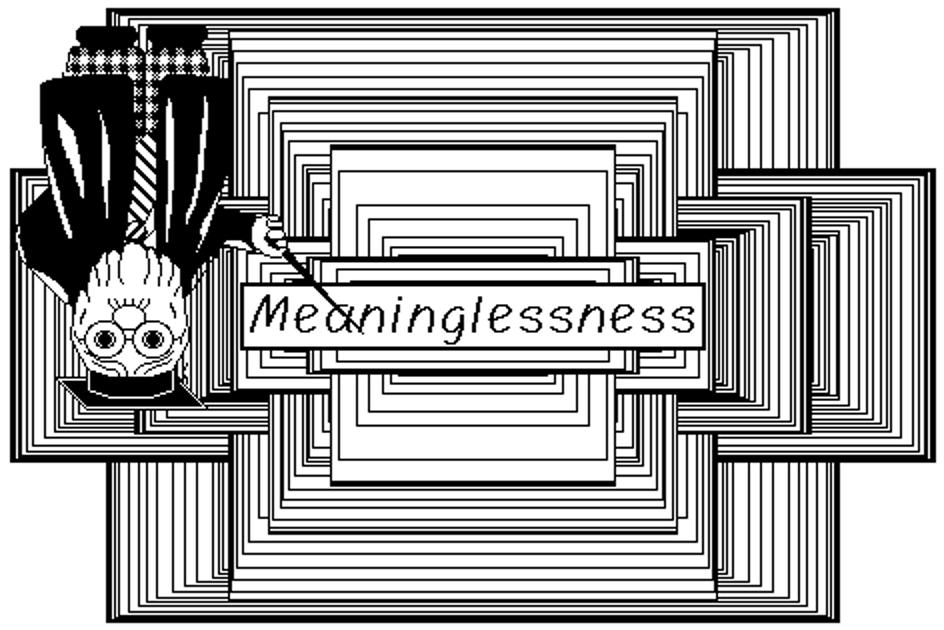
We are estranged from that which tells us who we are and why we are here. The anxiety of meaninglessness relates to a loss of ultimate concern which gives meaning to our activities, especially our struggles. We can endure anything when it has a purpose; without one we are unable to perform even the implest of tasks. Without a central purpose, we are driven from devotion to one object, to another and another, as in each case we find either the meaning vanish or that what was a state of creativity, turn to indifference or aversion. The anxiety which arises, as the finite mind is met with paradox, is the result of the growing awareness of separateness and lack of universal participation. Coming to consciousness, becoming oneself entails a self-affirming act on meeting one’s nonbeing. the encounter brings about a realization of separation; one realizes one’s position as an individual participant within the whole. The anxiety is a barrier which, through the act of self-affirmation, is taken into oneself and thereby becomes the driving force urging the person to act heroically.
During infancy, one might imagine there being, in psychoanalytic terms, a state of primary narcissism. The person here is continuous with the larger structure and in a state of unconscious wholeness. This wholeness would be felt as good and eternal, it being an aspect of the creative self-affirmation of all existence emerging from the void. At birth the person is endowed with certain characteristics and a set of life circumstances. It is a pluripotential state from which one brings oneself into existence as one relates to what the fates bring.
The infant awakens to himself as a separate entity through hunger. His structure has to incorporate other structure be it material or psychological into itself. The psychophysiological event of anxiety that comes with hunger is the trigger and the core of the demands for food and affection.
The person develops into himself as a separate entity as he meets anxiety at each developmental level. At each stage he is met with the facts of his finitude and separation from the totality. He finds himself standing alone on his strength. Freud,Bowlby, Mahler, Klein, and many others have described what they see as occurring during the period of child development. The early history is clearly important as it forms the foundations of the personality and because one is usually never as weak and dependent on others.
At times, in the course of one’s life, however, one may try to forge ahead heroically but is rendered impotent by the paradoxical quality of our finite existence. One’s efforts are not enough and meets oneself as weak, powerless, and insignificant. To avoid despair one is driven to find greatness in oneself or borrow it from a powerful other.
The fact of our existential position remains and emerges with the full force of anxiety and despair whenever it is reawoken by disappointment. As outlined by Self-Psychology, a fragmented, regressive state ensues as once again the illusion is seen through and the person attempts to retreat from the overpowering experience. Occurring in small increments however, the confrontation with one’s limits allows one the opportunity to overcome his condition in reality. Onecomes to a growing awareness of oneself. In one’s solitude one is also able to see the other, not as a mirror providing one with an image of oneslf, nor as a source of power and direction, not even as a twin who enables him to love and accept himself. In the end one is alone in being oneself not as an image or a role, not living on borrowed strength and love. One is the truth of one’s own will.
There is also a shift in emphasis from the past to the present and from understanding to action. Though one’s alienation developed at different points in the past, the dilemma is current; this is the moment in which one determines and carries out one’s future course.
In terms of drives, we can understand the situation as involving the sublimation of prerational forces. There are yearnings within us that seek expression. The task in life might be seen as, not so much a refinement or redirection of these yearnings from their original aims, but rather the discovery and creation of rational objects to give them fulfillment.
 Louis Canella, M.D.